In short
Cycling in Girona means three classic climbs close to the city: Els Àngels (11 km, the gentle first day), Rocacorba (14 km and 800 m of climbing from Banyoles) and Mare de Déu del Mont (18 km, 1,111 m). Add the Carrilet greenway to the coast, gravel tracks in the Gavarres and coffee at La Fàbrica.
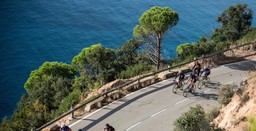
Girona sits between the high Pyrenees and the Costa Brava, and a week of riding here reaches both. The roads out of town lead to forest climbs the pros use to test their form and to quiet lanes across the vineyards of the Empordà. An old railway line rolls all the way to the beach at Sant Feliu de Guíxols. The day ends back in the Barri Vell, the old town, where the cycling cafés sit.
Which climbs should you ride from Girona?
Start with Els Àngels, save Rocacorba for fresh legs and give Mare de Déu del Mont your longest day. Santa Pellaia, Sant Martí Sacalm and the coast and mountain climbs fill the rest of the week, each with its own reason to go.
How hard is Els Àngels?
Els Àngels is the easy one, and the climb to ride on your first day. From the city it runs 11 km with 481 m of climbing, at an average of about 3%. The smooth road winds through woodland, with some switchbacks and a couple of short downhills. Where the trees open you reach the Santuari dels Àngels cross. Turn left and ride 500 m more to the monastery, where Salvador Dalí and Gala married in 1958, for the view over Girona and a snack counter for a refuel. From Madremanya on the far side it is about 12 km at 4.5%, and the approach from Girona through Quart on the GI-6531 is about 20 km. Simon Yates, Kasia Niewiadoma and Robert Gesink have all trained here. The gentle profile keeps a mixed group together, which makes it the climb for a first ride, a recovery spin or a friend who is newer to the hills.
Why does everyone talk about Rocacorba?
Rocacorba is the climb riders use to measure themselves. Pro riders have long used it as a fitness test, and that put it on the international map. It starts at Banyoles, 27 km from the centre of Girona, and climbs through forest to a cluster of radio masts. Lengths run from 12 to 14 km depending on where you start the clock; the full climb is 14 km with 800 m of climbing. The first three kilometres average around 5.7%, then a short breather gives way to ramps averaging 9.5%. Rocacorba is a dead end, so you come down the same narrow road, technical in places: keep some focus for it. On a clear day the top looks north to the Pyrenees and east to the Mediterranean. A loop from Girona through the Pla de l'Estany to Banyoles, up and back, is about 90 km with 1,200 m of climbing. Refill at Banyoles lake on the way home.
Is Mare de Déu del Mont worth a whole day?
Mare de Déu del Mont is the big day of the week, and it earns the effort. The climb is 18 km with 1,111 m of climbing on a quiet, narrow road between the Garrotxa and Alt Empordà regions. From Bàscara it is roughly 20 km of climbing, the last 7 km on narrow road through forest, with the final kilometres averaging closer to 8%. At the top is the shrine of Mare de Déu del Mont and a sculpture of the poet Verdaguer, with the Pyrenees behind. Ride out from Girona on the Empordà roads north to Bàscara, climb, descend and loop back: 120 to 140 km and close to 2,000 m of climbing, depending on your roads. There is nowhere to buy anything on the upper section, so pack food and fill both bottles before the climb. It suits strong riders on their biggest day of the week, ideally a group happy to share the work across the flat Empordà on the way out.
Which other climbs earn a place in the week?
Five more climbs round out a week, each for a different day. Santa Pellaia is 6 km at 3% from Cassà de la Selva, with 210 m of climbing on a quiet road under a tree canopy. A medieval church waits at the top, and the shade makes it the one for a hot afternoon. Sant Martí Sacalm climbs 9 km at 7% from Amer, 606 m on a smooth road that never levels out, to a village with a café. Sant Grau, also known as Cadiretes, is 7 km with 472 m of climbing. It leaves the coast road between Tossa de Mar and Sant Feliu de Guíxols, which The Telegraph placed among the world's top 10 cycling roads. Sant Pere de Rodes is 8.8 km with 517 m to the Romanesque monastery, best at sunrise over the sea. Vallter is the high one, 12 km with 1,100 m of climbing through 180° bends to the Vallter 2000 ski resort.
No hosted cycling trip in Girona yet. Want to hear first when there is one?
No password. We email you a 6-digit code.
Where can you ride gravel near Girona?
Gravel around Girona comes in two kinds: the Carrilet greenways on old railway lines, gentle and away from cars, and the forest tracks of the Gavarres massif between the city and the coast.
Where do the Carrilet greenways go?
The Carrilet greenways are the easiest gravel riding around Girona, built on two old railway lines. The Carrilet greenway from Girona to Sant Feliu de Guíxols runs 39.33 km on compacted soil through Quart, Llambilles, Cassà de la Selva, Llagostera, Santa Cristina d'Aro and Castell d'Aro to the sea. For decades that railway was how Girona's residents reached the beaches at Sant Feliu. Inland, the Carrilet greenway from Olot to Girona drops from 440 m at Olot to 70 m at Girona. It rises to 600 m at the Coll d'en Bas on the way, so it rides best from Olot. Joined by a signposted 22 km section over the Coll de Sentigosa, the two lines carry you more than 150 km from the high Pyrenees to the Costa Brava. The coast line also links to the Pirinexus route and EuroVelo 8. Either greenway suits a recovery day, a family ride or a road rider trying gravel for the first time.
Where do gravel riders head in the Gavarres?
For proper gravel, ride into the Gavarres, where wide forestry tracks, singletrack and linking roads let you build loops of any length; 40 to 45 mm tyres suit most of it. Two café rides show the range. The Dos Kiwis and Rustik route, 74 km, follows the river north out of Girona around the Gavarres and rolls across the flat farmland of the Empordà. The Mooma route, 96 km with 1,100 m of climbing, takes the gravel track up Montnegre and drops through La Bisbal, the ceramics town, before Mooma's apple specials. The Traka gravel race showcases the tracks around the city. In September the Sea Otter Europe cycling festival brings a UCI Gravel World Series race to Girona. In 2026 it ran 109 km with 940 m of climbing from Juià, and amateurs raced by age group for a place at the World Championship. The next Sea Otter Cyclobrava is on 17, 18 and 19 September 2027.
Where do riders stop for coffee in Girona?
In town, riders regroup at La Fàbrica and the cafés around it; out on the road, the stop is planned into the route.
Which old town cafés do riders meet at?
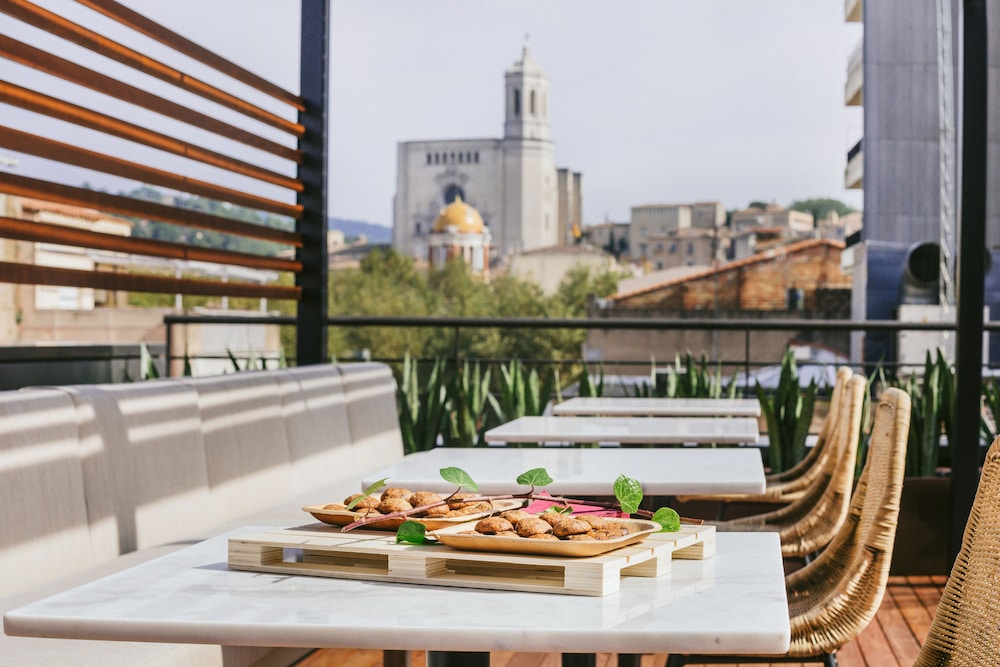
La Fàbrica, at Carrer de la Llebre 3 on the north edge of the old town, opened in 2014 and is still the first choice for many road riders visiting Girona. A German-Canadian couple, Christian and Amber, run it; he is a former pro. The beans are roasted in town at Espresso Mafia, their second café at Carrer de la Cort Reial 5, which works more as a coffee bar than a place to linger. Federal, at Carrer de la Força 9 near the cathedral. It suits a sit-down brunch, burgers or tapas once the ride is done. La Comuna, at Carrer de la Barca 34, serves a breakfast burrito and bircher muesli, with outdoor seating. Eat Sleep Cycle has its own bike café in the Barri Vell too. Order like a local: cafè amb llet is coffee with milk, cafè sol an espresso.
Where do you refuel out on the road?
Out of town, the café is the point of the ride. La Pera and the medieval villages is a 50 km road loop with a coffee stop in La Pera, a tiny village close to Monells. At Bar Restaurant L'Escola, the dessert menu is the draw. The Costa Brava cake run is 115 km with 1,800 m of climbing along the coast, stopping at Dulce Pikika in Platja d'Aro, with a hard climb straight after the cake. La Antiga Fàbrica, on a relaxed 40 km loop south of Girona, gives a lunchtime ride its coffee. On the Mooma gravel route, Pastisseria Cafeteria Font in La Bisbal is the place for a slice of cake. On the climbs, the snack counter at the Els Àngels monastery and the village café at Sant Martí Sacalm are the stops. La Pera suits an easy group day; the cake run suits a strong group, best in spring or autumn when the coast roads are quieter.
Which months suit which rides?
Ride Girona from March to May or from September to November: the best months for long days, when the cycling community is out in force. In March the Volta a Catalunya, one of the world's oldest stage races, brings the WorldTour peloton through the province. Spring highs climb from 16.6°C in March to 22.8°C in May, though May also has the most days with rain or snow, 11.1 on average. Autumn eases from 26.2°C in September to 16.7°C in November. July and August average highs above 31°C, so ride early and pick shaded climbs like Santa Pellaia. The peak months mean busier roads and trails, and the winter months fewer organised rides and less predictable weather. Whatever the month, watch for the Tramuntana, a strong north wind that makes the flat coastal routes much harder. The table shows Girona's average daily high and low and the days with rain or snow each month, from Open-Meteo data for 2016 to 2025.
| Month | High | Low | Rain or snow days |
|---|---|---|---|
| January | 12.9 °C | 2.8 °C | 5.3 |
| February | 15.1 °C | 4.7 °C | 6.9 |
| March | 16.6 °C | 6.5 °C | 9.5 |
| April | 19.2 °C | 8.7 °C | 9.3 |
| May | 22.8 °C | 12.2 °C | 11.1 |
| June | 28.2 °C | 17.2 °C | 8.9 |
| July | 31.3 °C | 19.9 °C | 6.1 |
| August | 31.4 °C | 20.0 °C | 6.8 |
| September | 26.2 °C | 16.2 °C | 9.7 |
| October | 22.3 °C | 12.9 °C | 8.8 |
| November | 16.7 °C | 7.6 °C | 8.1 |
| December | 14.0 °C | 4.1 °C | 6.6 |
Stay in Girona and ride from the door
Base yourself in Girona itself: Els Àngels starts from the city, the Carrilet greenway leaves from it, and the cycling cafés sit in the Barri Vell. Hotel Gran Ultonia, one of the cycling-friendly hotels theKlub picks in Girona, is 4-star with a guest rating of 9.0 out of 10.

Ciutat de Girona, also 4-star, and the 3-star Hotel Costabella score 9.0 too. Hotel Nord 1901 (8.8 from 2,786 reviews) and Carlemany Girona (8.7 from 2,336) are 4-star as well. A city base suits a group best: everyone rolls out together, splits by pace for the climb and meets again over coffee. To compare these hotels side by side, see our page for cycling in Girona.
Where to stay
Cycling hotels in Girona
Hotels we picked for the sport: the right location, and the facilities an active stay needs.



Frequently asked questions
Is Girona good for beginner cyclists?
Yes. Els Àngels climbs 11 km from the city at an average of about 3%, Santa Pellaia is 6 km at 3% in the shade, and the Carrilet greenway runs 39.33 km to Sant Feliu de Guíxols on compacted soil away from traffic. The Empordà lanes north of the city are gentle and quiet too.
Should you bring your own bike to Girona or rent one?
Both work. Shops such as Eat Sleep Cycle hire the latest carbon road and gravel bikes with a professional fitting, which spares you flying with a bike and the risk of damage. Book weeks ahead for May or September. With a specific bike fit or a big climbing week planned, bring your own bike.
Where can you refill bottles on a Girona ride?
In the villages. Most routes pass through medieval villages with public fountains, called fonts, and cafés, but the mountain summits have no water. Carry two bottles with electrolytes, even on spring mornings. After Rocacorba, refill at Banyoles lake; on Mare de Déu del Mont, nothing is for sale on the upper section.
How many days do you need for cycling in Girona?
Plan a week. That gives you the three headline climbs, a greenway or gravel day and a long café ride, with easier days between them. Put Els Àngels first, Rocacorba once your legs have settled, and keep Mare de Déu del Mont for the longest day, at 120 to 140 km from Girona.
Girona rewards a week with room in it: one big climb, one easy day on the Carrilet, one long café ride, and plenty of espresso in between. For more places to ride, browse cycling holidays with theKlub, and meet one of our hosts in The Inside Line with Marta Torà Milà. Before you fly, write Els Àngels into day one of the plan.