

In short
Cycling in Calpe means mild winter riding on the roads the pros use: in December and January most WorldTour teams train within 50 km of the town. Ride the Coll de Rates, 6.5 km at 5.4 per cent, then the steep Cumbre del Sol and the Vall de Laguar, from a base in Calpe, Altea, Dénia or Benidorm.
In winter the beaches at Calpe are nearly empty. The roads inland are a different story. They fill with bikes. In December and January dozens of pros can pass you on the Coll de Rates on any day of the week. Fans at Café Seamos have watched Mathieu van der Poel and Demi Vollering stop for their espresso. Just out of town the climbs begin, lots of them, through orange groves and, depending on the season, pink almond blossom, with the Mediterranean spread out below from the tops.
Where to stay
Cycling hotels in Alicante
Hotels we picked for the sport: the right location, and the facilities an active stay needs.


Why do the pro teams spend the winter in Calpe?
Pro teams spend the winter in Calpe for mild weather, good roads and mountains that start just outside the town. Former pros Manuel Cardosa and Sérgio Paulinho first came with their team nearly two decades ago, because base training, the long steady miles that carry a season, needs mild weather in December and January. The coast roads can be busy, so most riders head inland. The climbs there are challenging but rarely steeper than 5 to 6 per cent, and the longest is about 15 km. Calpe gets more than 320 days of sunshine a year, and its hotels keep bike storage, mechanics and a buffet built for cyclists. In December and January a majority of the WorldTour teams, cycling's top division, are based within 50 km of the town. Soudal Quick-Step made Calpe its winter base by a formal partnership in July 2025, and its head coach, Koen Pelgrim, gave the reasons as "the terrain, the climate, the hospitality".
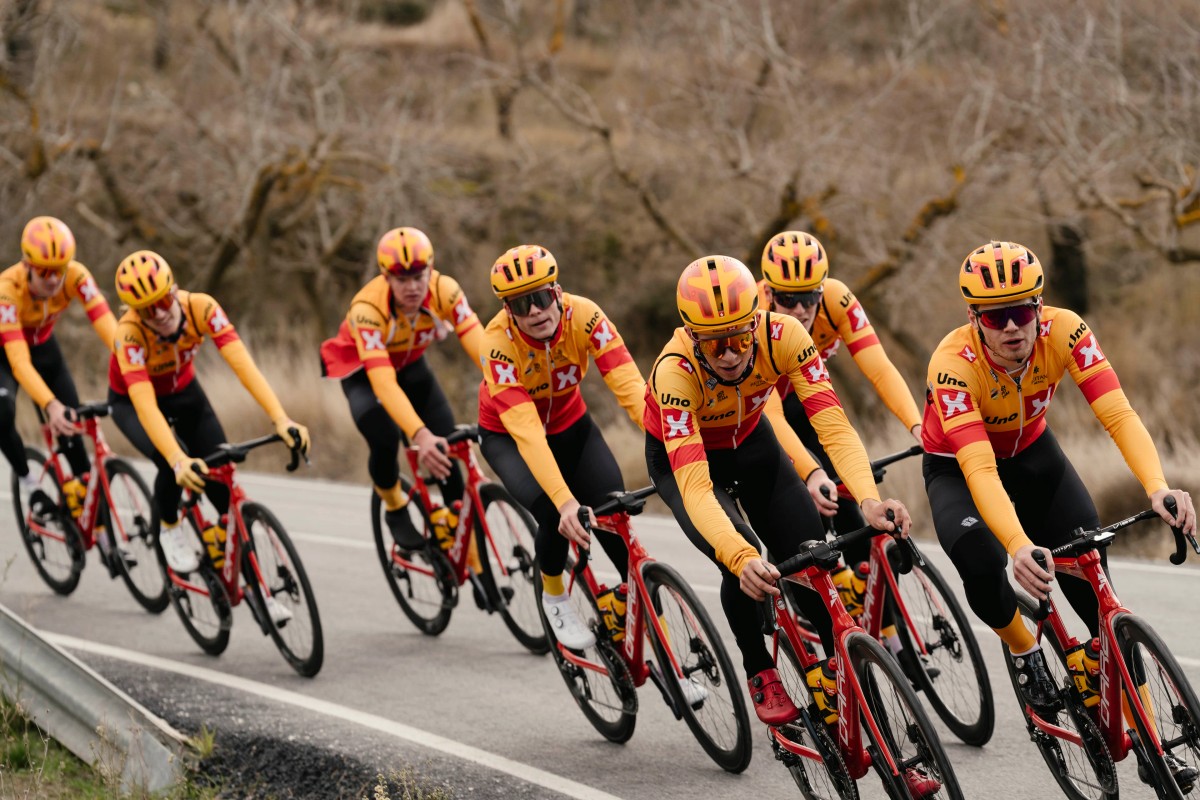
Which climbs do you ride from Calpe, and how hard are they?
The climbs riders come for are the Coll de Rates, the Cumbre del Sol, the Vall de Laguar and the long roads inland to Tudons and Confrides. Most sit 20 to 50 km from Calpe, to the north west and west, and each one rides differently.
How hard is the Coll de Rates?
The Coll de Rates is the climb everyone rides first, and the one the pros race each other up. From Parcent it runs 6.5 km at an average of 5.4 per cent, gaining 351 m to a top at 627 m, and its steepest 100 m reach 8.6 per cent.
Three hairpins, a gradual build and smooth, recently resurfaced tarmac make it a climb you can pace. The fresh surface makes the descent a pleasure too. Riders call it the local test. Ride it early in the week, note your time, and ride it again at the end. The fastest time is 15 minutes. The views open over the Jalón valley as you climb, and in winter you will rarely ride it alone. Fill your bottles at the fountains in Parcent before you start. It suits every level, and it is the right first climb for anyone new to the area.
Which side of the Cumbre del Sol should you climb?
The Cumbre del Sol is the short, savage one, and one of the six passes the Vuelta a España keeps coming back for. It rises from close to sea level to about 400 m with double-digit ramps. The side the Vuelta has climbed several times, from Alcasar, is 3.2 km at 11.9 per cent, an average that leaves little room to recover. The road from Benitachell reaches the same top over 6.3 km at 6 per cent, close to the Coll de Rates in gradient and a little longer.
Riders who want to try a Grand Tour finish should take the Alcasar side with the lowest gear they have. A compact chainset, the smaller pair of front chainrings made for climbing, makes it far more manageable. Riders who want the view without the fight should climb from Benitachell. Both reward you with the same thing at the top: the Mediterranean laid out below.
What is the Vall de Laguar climb like?
The Vall de Laguar is the beautiful one, and it bites at the end. Turn off the CV-715 halfway between Orba and Tormos onto the CV-721. From there it is 11 km to the Coll de la Garga at 751 m, climbing 610 m at an average of 5.5 per cent. A 10 per cent ramp opens the climb, then hairpins climb at a kinder gradient through pine woods and old terraces of olive and almond trees. Campell and Fleix pass quickly, and at the far end of Fleix a spring by the old wash house is the place to refill.
Above Fleix the road looks into the Barranc de l'Infern gorge, with the plain running back to the sea behind you. Then comes Benimaurell, where the way through the village follows narrow, winding lanes, always the steepest line, and it stays steep to the pass, where there is a restaurant. It suits riders who will trade a hard last few kilometres for views in every direction from the pass.
Which climbs make a long day inland?
Tudons is the long one, and many local riders rank it their favourite. From the outskirts of Benidorm the road climbs for 20 km, from sea level to 1,024 m at about 5 per cent. It is a Cat 1 climb, one grade below the hardest in race classification. At the Tudons sign a restricted road turns off to the military base on the Aitana. The Vuelta has finished up there four times, in 2001, 2004, 2016 and 2019. In 2016 Nairo Quintana sealed the overall win there in a duel with Chris Froome.
Confrides is gentler, 7.5 km at 5 per cent to 970 m and within reach of most riders. Sa Creueta from Tárbena is 7.5 km at 3.4 per cent, away from the traffic. The Vall d'Ebo is 8 km at 6 per cent, with switchbacks and views to keep your mind off the gradient. Ride over it as part of a 100 km loop and you have a big day of 1,872 m of climbing.
No hosted cycling trip in Alicante yet. Want to hear first when there is one?
No password. We email you a 6-digit code.
Where should you stay: Calpe, Altea, Dénia or Benidorm?
Stay in Calpe to ride where the teams ride, in Benidorm to have Tudons on the doorstep, and in Altea or Dénia for two of the highest rated hotels on our list. The cycling-friendly hotels we rate across them are on our cycling in Alicante page.
Why base yourself in Calpe?
Calpe puts you in the middle of it. It is the town cyclists know, and the name riders use for the whole cluster of towns and villages around it, several of which make a good base too. The hotels in Calpe keep space to store bikes, offer mechanical help and serve a buffet built for riders, and the climbs start 20 to 50 km away. In December and January the cafe stop is where the pro and amateur worlds meet, and Café Seamos is the one fans name.
Winter is the town's quiet season, so the beaches are almost empty and a walk on the sand after the ride is an easy habit. AR Diamante Beach Spa & Convention Center is a four-star hotel in Calpe with a guest rating of 8.6 out of 10. Choose Calpe when the point of the week is to share the road with the pros and regroup at the same cafes.
When do Benidorm, Altea or Dénia suit you better?
Benidorm, 23 km south of Calpe, suits riders who want Tudons from the door, since the climb starts on the town's outskirts. It also has the widest choice of the hotels we rate, four of them. Hotel Don Pancho is a four-star designed for adults, rated 9.2 out of 10. Flamingo Beach Resort, another four-star, is recommended for adults too. Both suit riders travelling without children. Los Álamos, a four-star rated 8.1 across 1,208 reviews, and the three-star Hotel Gala Placidia, rated 8.3, complete the list.
In Altea, SH Villa Gadea is a five-star rated 9.1 out of 10 across 4,272 reviews, the most reviewed hotel on our list. In Dénia, Hotel Los Ángeles is a four-star rated 9.0. Compare all of them side by side on our Alicante cycling page before you choose.
When is the best time to ride Calpe?
Ride Calpe from December to April for the winter training season, or from April to June and September to November for the mildest long days. December and January are when the teams are in town, and most rides up the Coll de la Garga happen between December and April. March and April are the peak season, when the roads are busiest. The table below shows ten years of averages measured at Alicante, on the same coast: the daily high and low, and the days with 1 mm of rain or more.
| Month | High | Low | Rain or snow days |
|---|---|---|---|
| January | 16.6 °C | 8.2 °C | 3.1 |
| February | 17.2 °C | 9.1 °C | 3.3 |
| March | 18.5 °C | 10.7 °C | 7.9 |
| April | 19.9 °C | 12.7 °C | 6.4 |
| May | 23.1 °C | 16.0 °C | 4.3 |
| June | 27.1 °C | 20.4 °C | 2.1 |
| July | 29.8 °C | 23.4 °C | 1.3 |
| August | 30.2 °C | 23.7 °C | 1.9 |
| September | 27.6 °C | 20.8 °C | 5.5 |
| October | 24.3 °C | 17.0 °C | 5.7 |
| November | 20.3 °C | 12.3 °C | 4.9 |
| December | 17.5 °C | 9.6 °C | 3.8 |
From December to February the coast averages highs of 16.6 to 17.5°C with only three or four wet days a month, which is why the base miles happen here. March is the wettest month in the table, with 7.9 days of rain. By July and August highs reach about 30°C, so summer riding means early starts and two bottles. The racing calendar follows the season: the Volta a la Comunitat Valenciana in February, the Costa Blanca Bike Race early in the year and the TotalEnergies Gran Fondo Alberto Contador in September.
Frequently asked questions
Is Calpe good for cyclists who are new to climbing?
Yes, if you choose your climbs. Most hold 5 to 6 per cent and are never too steep. Confrides, 7.5 km at 5 per cent, is within reach of most riders, and Sa Creueta from Tárbena averages 3.4 per cent. A compact chainset helps on all of them. Save the Cumbre del Sol's 11.9 per cent side for later.
Should you bring your own bike to Calpe or rent one?
Renting works well on a first visit to the area. Make sure the frame size and groupset match your position, shoes and pedals, and choose a compact chainset for the climbs. Riders with a specific bike fit, or a big climbing week planned, should bring their own bike. Calpe's hotels keep space to store bikes and offer mechanical help.
Where can you refill bottles on rides inland from Calpe?
The mountain villages have public drinking fountains, above all in Parcent, at the foot of the Coll de Rates, and in Alcalalí. On the Vall de Laguar, a spring by the old wash house at the far end of Fleix is the place to top up. In summer carry two bottles: the heat between climbs is intense.
Do the Vuelta a España and other races use the roads around Calpe?
Yes. The Vuelta a España returns regularly for six passes: the Alto de Aitana, the Xorret de Catí, the Coll de Rates, La Carrasqueta, the Port de Tudons and the Cumbre del Sol. The Volta a la Comunitat Valenciana runs in February, and amateur riders can take on the TotalEnergies Gran Fondo Alberto Contador every September.
Give the first day an easy start. The former pros who guide riders here say you find a good rhythm after a day or two. Save the Cumbre del Sol and the long Tudons day for the end of the week. If you are weighing the Costa Blanca against an island, our guide to a cycling holiday in Mallorca covers the other big winter base, and cycling holidays with theKlub gathers every place we ride. Book your base first, then make the Coll de Rates your first climb and note your time for a rematch at the end of the week.


